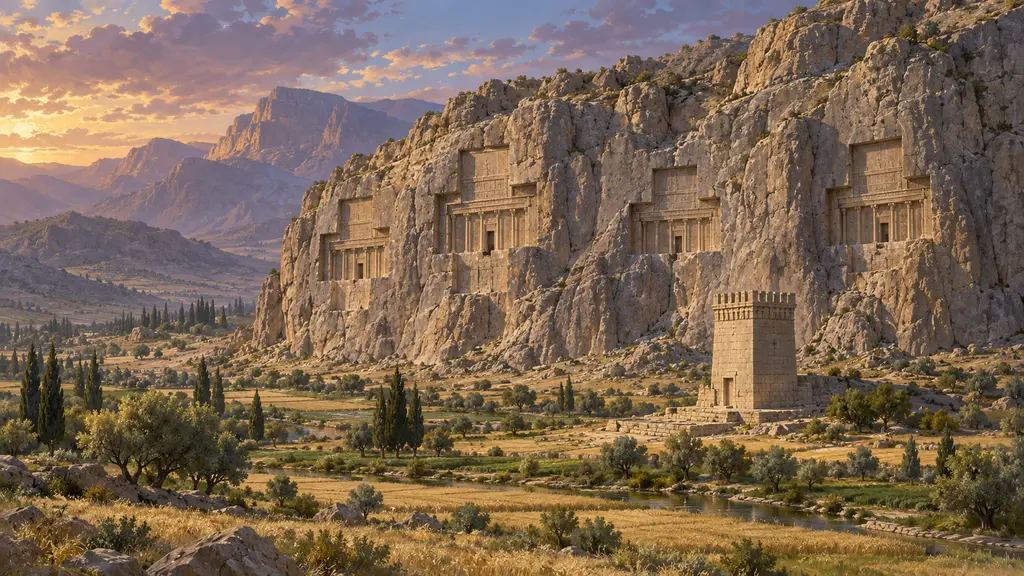
Naqsh-e Rostam
Cliff of royal rock tombs near Persepolis, cut from Darius's reign (522-486 BCE)
In the game: Level 4: The Terrace
Naqsh-e Rostam is a limestone cliff a short distance north-west of Persepolis where Darius I had his tomb cut high in the rock. Three more tombs of the same design were later carved beside it, probably for his successors. The tomb fronts, with their inscriptions and reliefs, are among the clearest statements of how the Achaemenid kings wished their rule to be seen.
In the game: The game mentions the cliff in a chronicle note on the royal tombs near Persepolis. The note gives the three later tombs to later kings. Those tombs carry no inscriptions, and none is known to have been cut before 479, when the game ends.
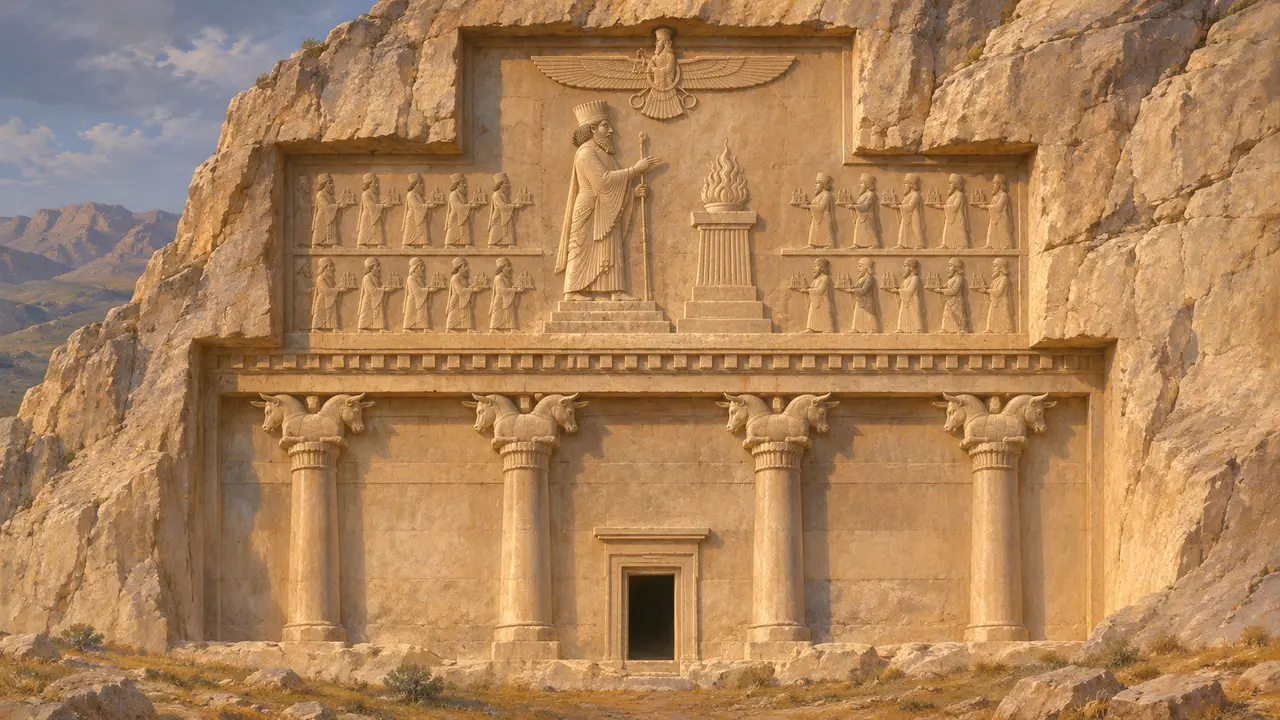
The tomb of Darius
In the recordOnly one of the four tombs names its owner. Two Old Persian inscriptions, with Elamite and Akkadian versions, are carved on its front. In DNa Darius names Auramazda as the giver of his kingship and lists the lands he held. In DNb he describes his own virtues: just to the weak and the strong, in control of his anger, and skilled as a horseman, archer and spearman.
DNa; DNb; R. G. Kent, Old Persian, 1953
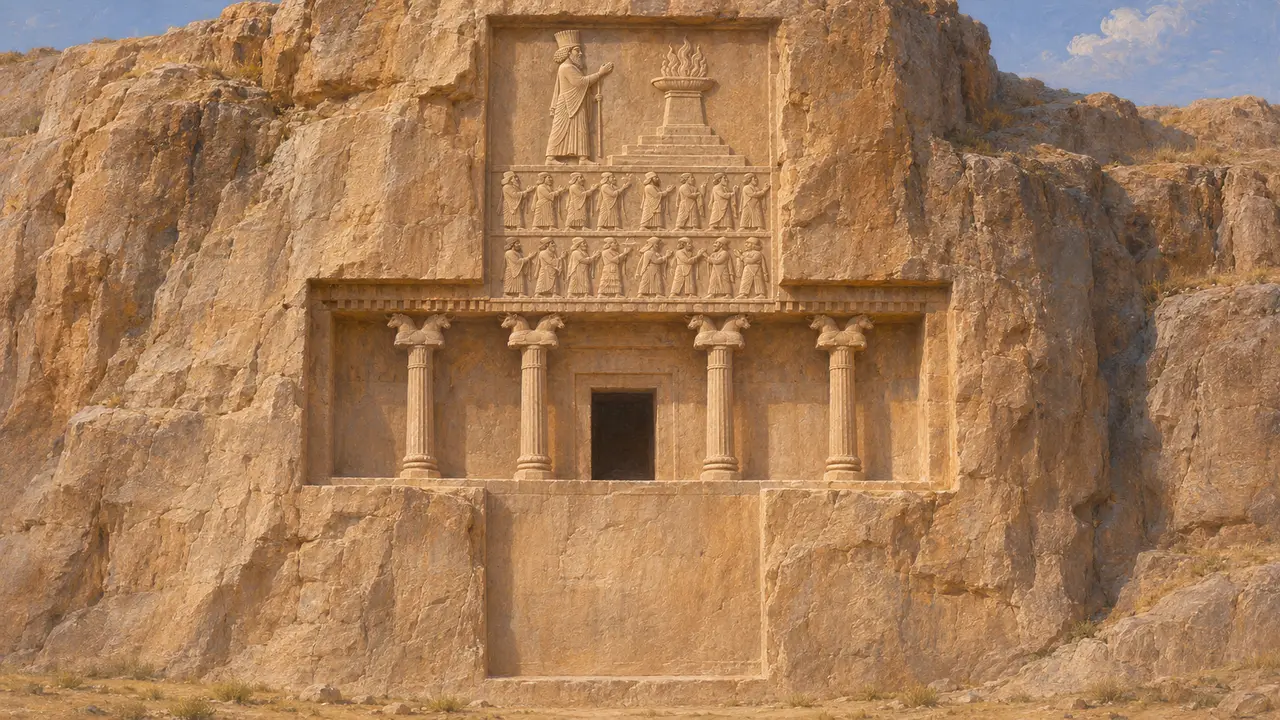
A palace porch carved in the cliff
In the recordEach tomb front is cut in the shape of a cross. The middle band copies a palace porch with four columns and a doorway. The doorway leads to burial chambers, where cists cut into the rock held the bodies. Above, the King stands on a stepped platform before a fire altar, on a dais carried by figures of the subject peoples. On Darius's tomb these bearers are labelled, and DNa invites the viewer to look at them to learn how many lands he held.
E. F. Schmidt, Persepolis III, 1970; M. C. Root, The King and Kingship in Achaemenid Art, 1979
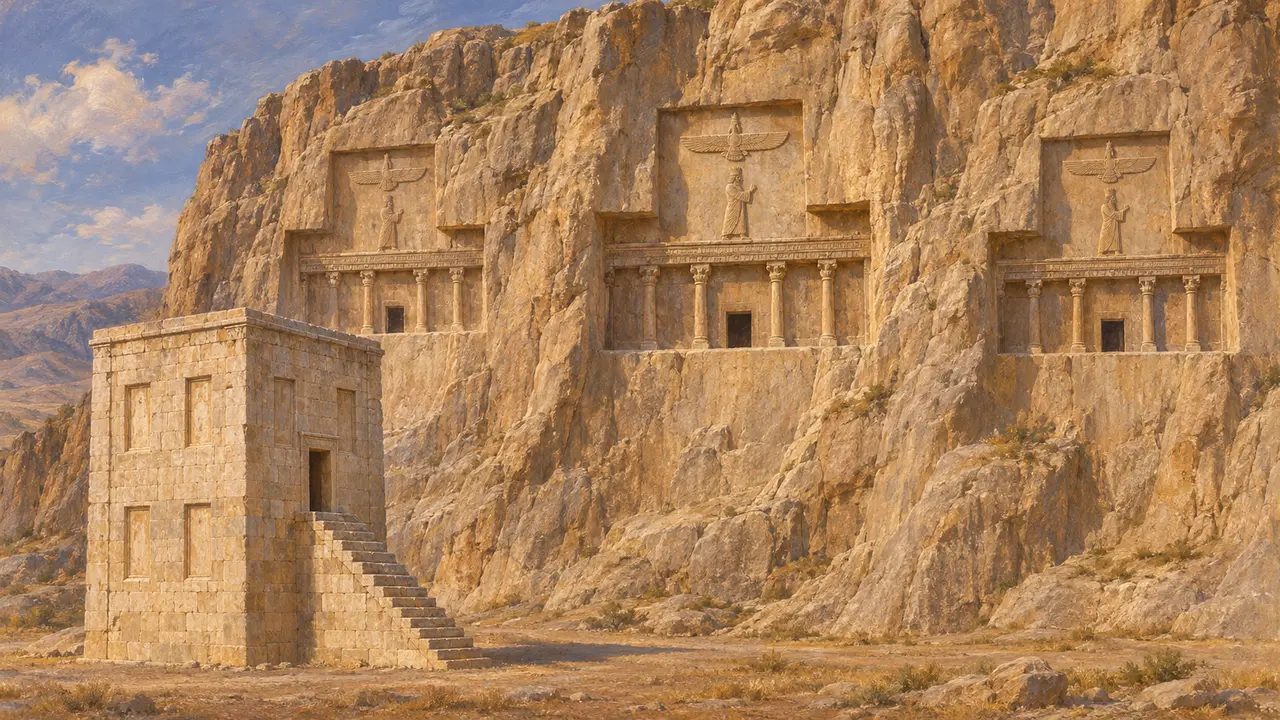
Who lies in the other tombs
DisputedThe three uninscribed tombs are usually given to Xerxes, Artaxerxes I and Darius II. This rests on their order and style, not on any text. Scholars also argue over the winged figure above the King, read either as Auramazda or as a symbol of royal fortune. They also disagree about the stone tower facing the cliff, called the Ka'ba-ye Zartosht, which has been explained as a tomb, a store for royal objects or a shrine.
P. Briant, From Cyrus to Alexander, 2002; E. F. Schmidt, Persepolis III, 1970
Ctesias on the King's parents
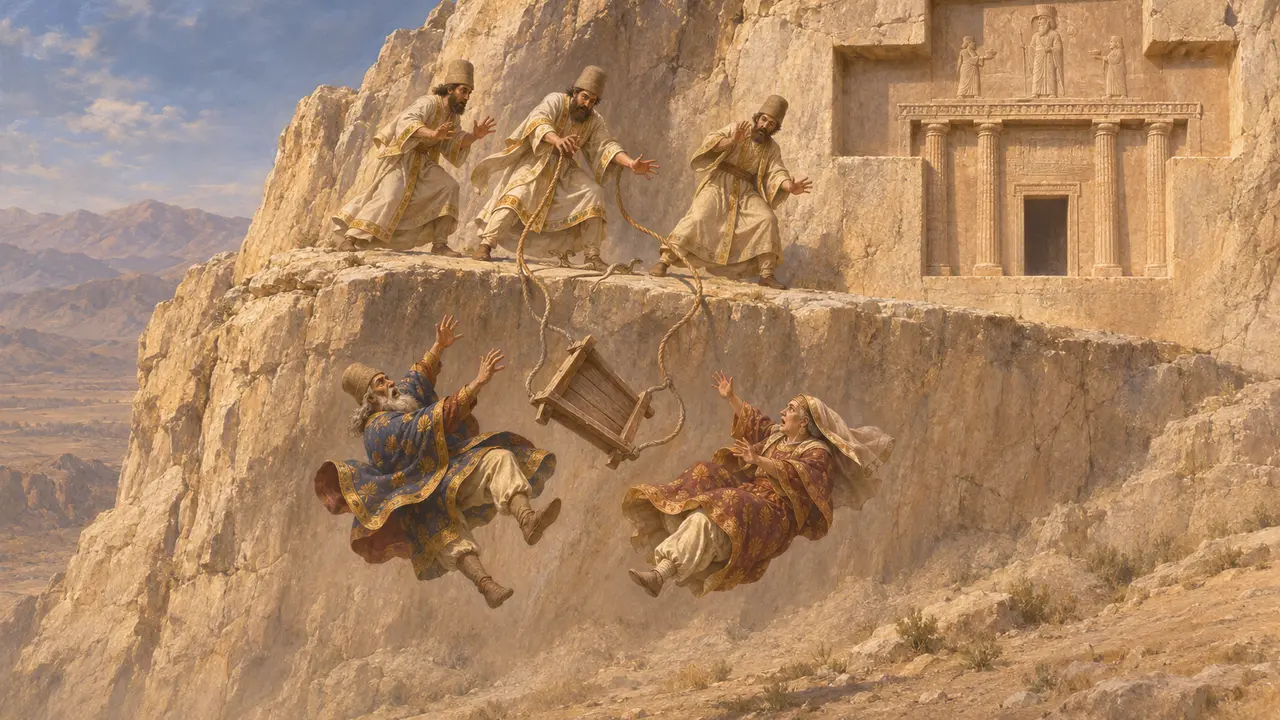
Ancient accountCtesias, a Greek physician at the later Persian court, tells that Darius wanted to see his tomb but was talked out of going up himself. His father and mother were hauled up the cliff instead by priests pulling on ropes. Frightened by snakes, the priests let go and both parents fell to their deaths. The story survives only in a later summary, and historians treat it with caution.
Ctesias, Persica (epitome of Photius)
The name of Rostam
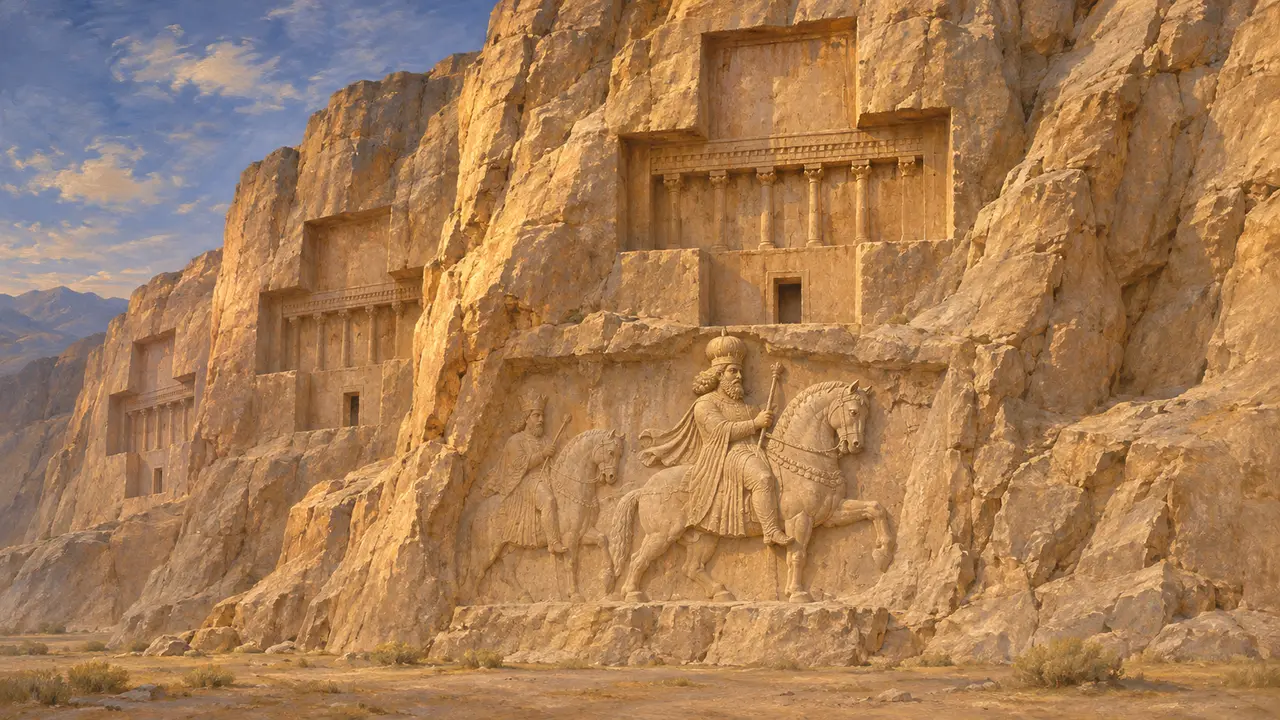
Later legendThe name means picture of Rostam. Long after the Achaemenids, local people took the carvings at the site for images of Rostam, the hero of Persian epic. These carvings include later Sasanian reliefs of mounted kings. Nothing suggests the Achaemenid kings knew of him, and the name says nothing about who made the tombs.
E. F. Schmidt, Persepolis III, 1970
Sources
- E. F. Schmidt, Persepolis III: The Royal Tombs and Other Monuments, 1970
- R. G. Kent, Old Persian: Grammar, Texts, Lexicon, 1953
- M. C. Root, The King and Kingship in Achaemenid Art, 1979
- P. Briant, From Cyrus to Alexander, 2002
- A. Kuhrt, The Persian Empire, 2007
- Ctesias, Persica (epitome of Photius)