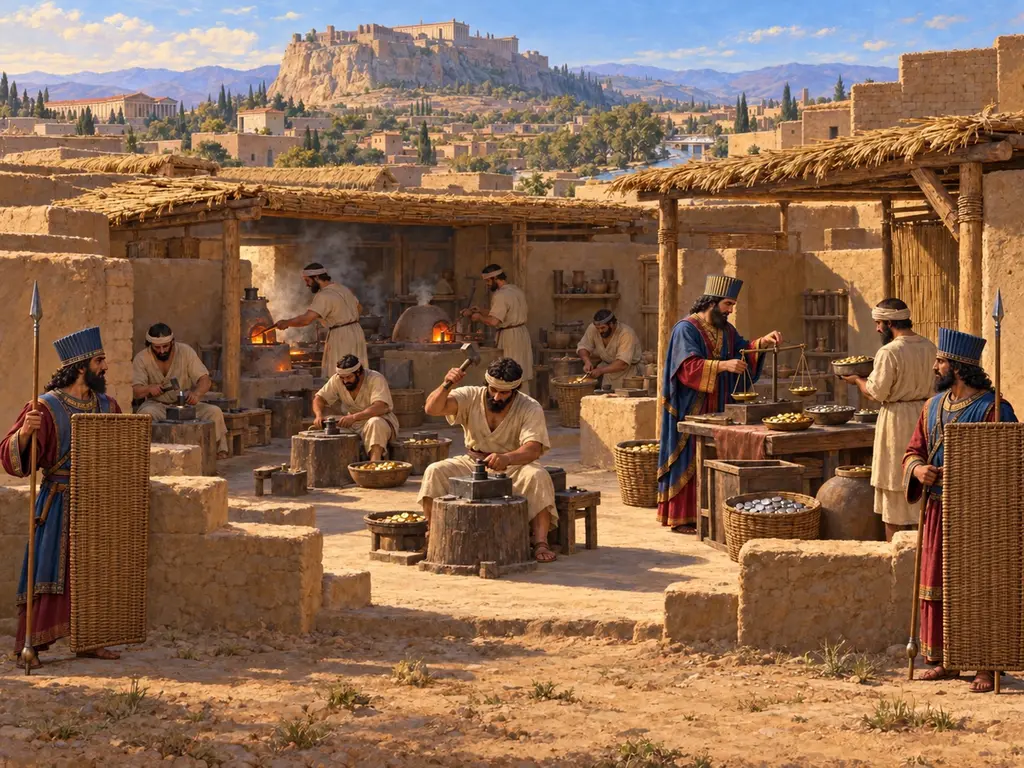
Royal Mint
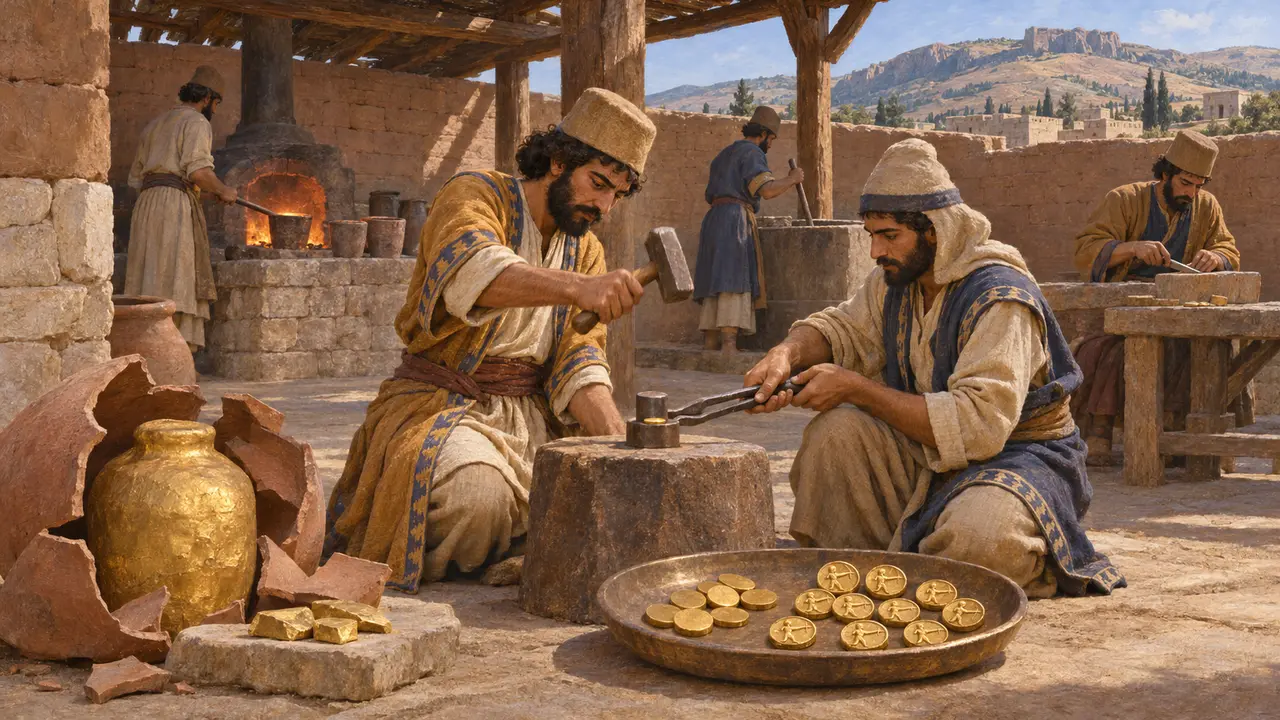
Workshop striking the King's archer coins, probably at Sardis, about 500 BCE
In the game: Level 7: Sardis Burns, Level 8: The Bay of Marathon, Level 9: The Canal, Level 10: The Hot Gates, Level 11: The Finale
Between about 515 and 500, Darius began issuing royal coins: gold darics and silver sigloi showing the King as an archer. Sardis, the old Lydian capital where, Herodotus says, the first gold and silver coins were struck, was probably their main mint. The coins mostly served the western provinces, paying soldiers and settling dues, while most of the empire still counted wealth in weighed silver and goods.
In the game: The mint at Sardis turns storeyard gold, also needed by the citadel and fleet, into a fixed 12 silver per gold for the treasury. The rate is a game simplification; Herodotus reckoned gold at 13 times silver.
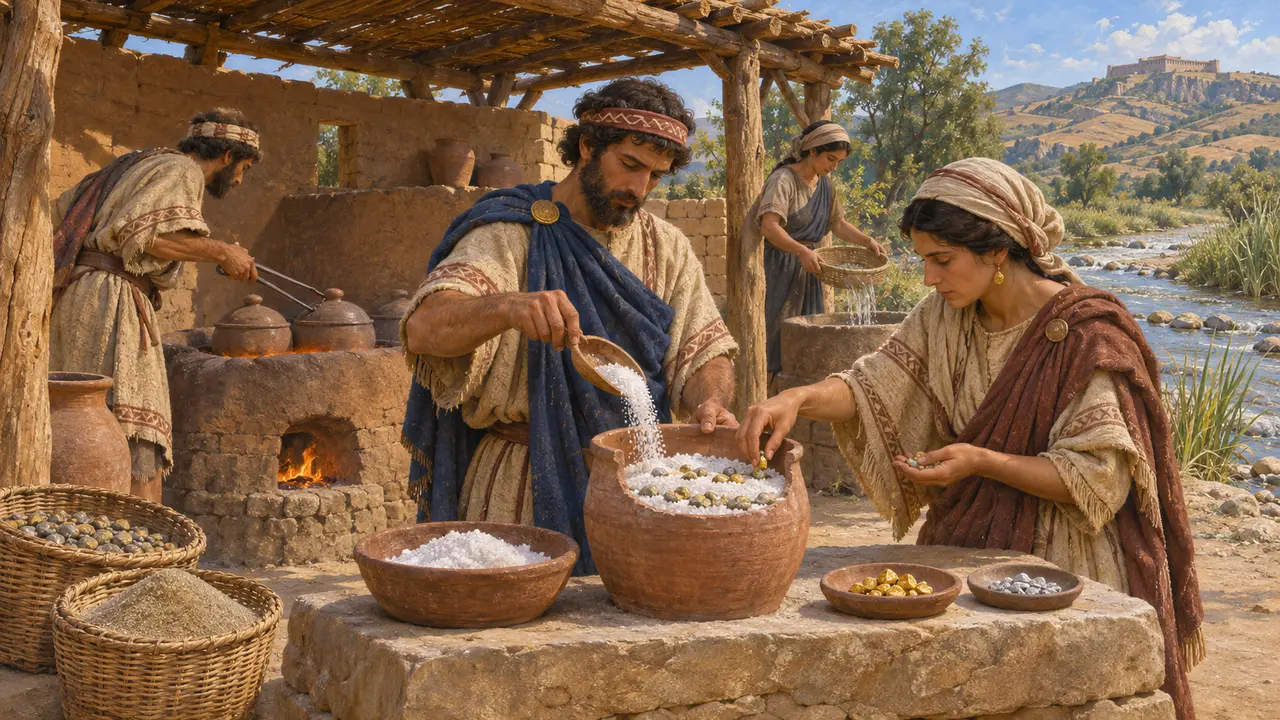
Gold from the Pactolus
In the recordExcavators at Sardis found a gold refinery beside the Pactolus stream, dated to the Lydian period in the sixth century. Workers there separated gold from the natural gold and silver alloy of the river sands by heating it with salt. This made it possible to strike coins of pure gold and pure silver instead of the mixed electrum of the earliest Lydian coins.
A. Ramage and P. Craddock, King Croesus' Gold, 2000
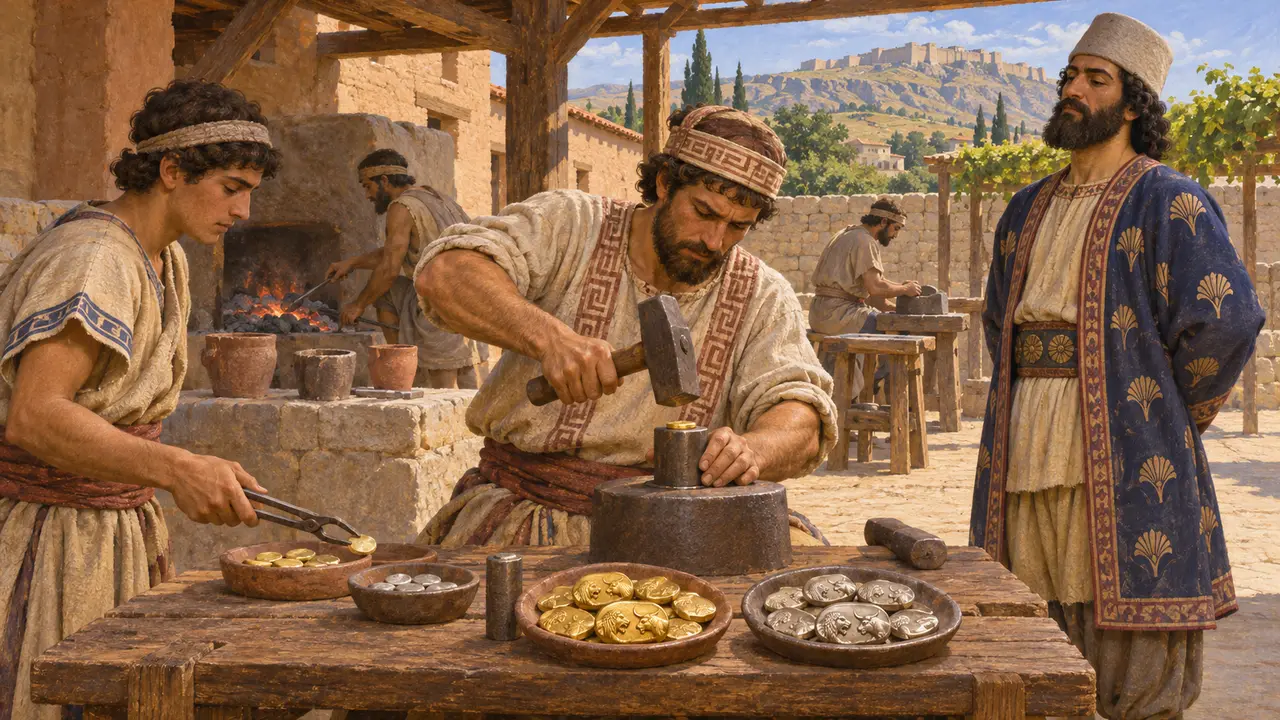
Lydian coins under Persian rule
DisputedHerodotus says the Lydians were the first people to strike gold and silver coins. Gold and silver pieces showing a lion and a bull, called Croeseids, are traditionally given to Croesus. Some numismatists argue that many of them, especially the lighter issues, were struck by the Persians at Sardis after its capture in about 546, before Darius created his own designs.
Herodotus 1.94; I. Carradice, The 'regal' coinage of the Persian empire, 1987
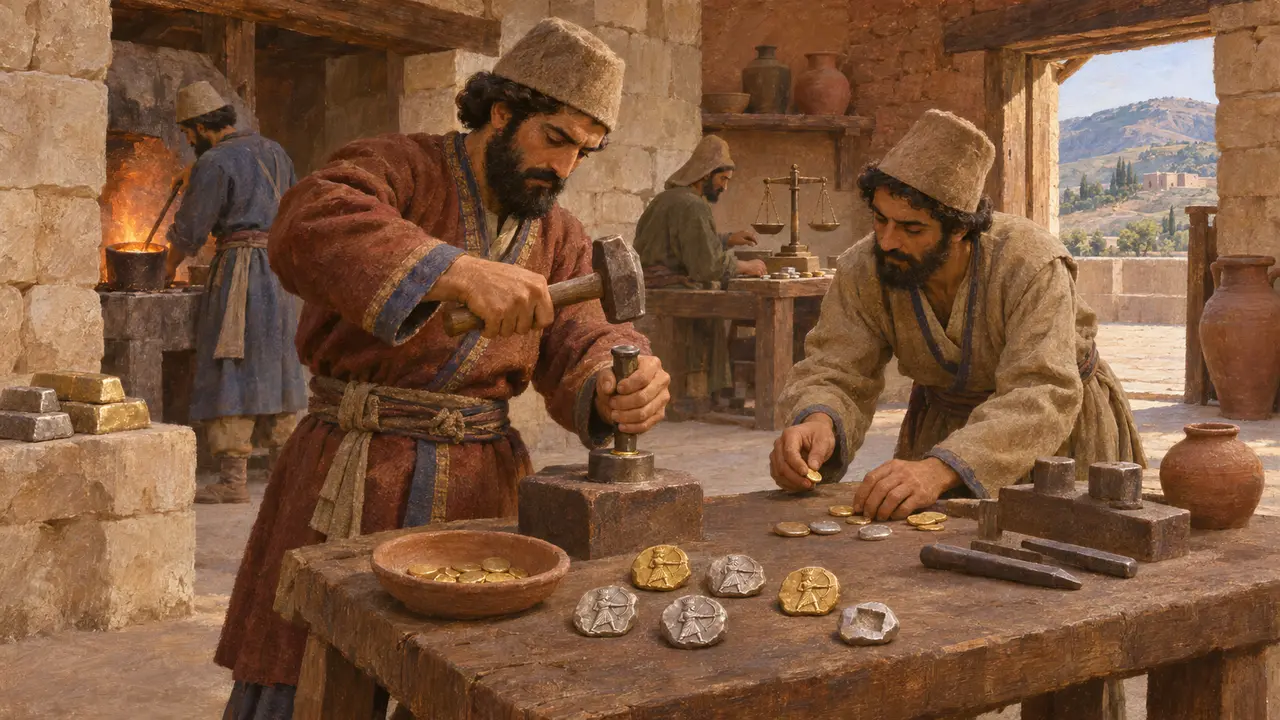
The royal archer coins
In the recordThe surviving coins show a crowned figure with a bow. The earliest show him half-length, and later issues show him kneeling to shoot or running with bow and spear. The reverse carries only a rough punch mark, with no inscription. A seal used on Persepolis Fortification tablets dated 500 was made from an archer siglos, which shows the coins existed by then. Whether the name daric comes from Darius himself is still debated.
M. C. Root, Evidence from Persepolis for the dating of Persian and archaic Greek coinage, 1988
Herodotus on the King's pure gold
Ancient accountHerodotus says Darius struck coins of gold refined to the highest purity. He adds that Aryandes, governor of Egypt, issued silver of equal purity to rival the King, and Darius had him killed on a charge of rebellion. Elsewhere Herodotus says the tribute was melted and poured into clay jars, which were then broken, and pieces were cut off as needed.
Herodotus 4.166; Herodotus 3.96
Where the coins were used
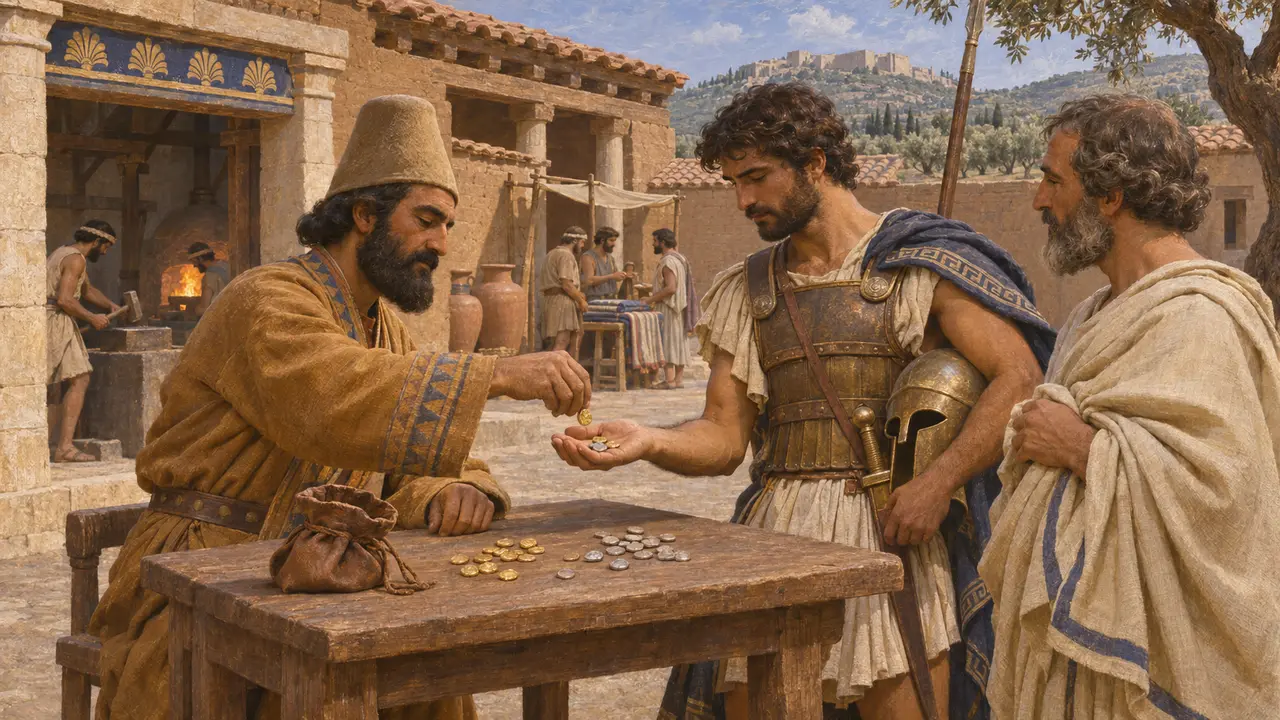
In the recordDarics and sigloi are found mostly in western Asia Minor and seldom in Persia, Babylonia or Egypt. In the heartland, officials recorded wages in barley, wine and livestock, and the Persepolis Treasury tablets give silver by weight. Coins were therefore a tool for the western provinces, where Greek cities, soldiers and mercenaries were used to coined money.
P. Briant, From Cyrus to Alexander, 2002; I. Carradice, The 'regal' coinage of the Persian empire, 1987
Sources
- Herodotus 1.94; 3.95-96; 4.166
- M. C. Root, Evidence from Persepolis for the dating of Persian and archaic Greek coinage, 1988
- I. Carradice, The 'regal' coinage of the Persian empire, 1987
- A. Ramage and P. Craddock, King Croesus' Gold, 2000
- P. Briant, From Cyrus to Alexander, 2002