Encyclopedia › Battles and events
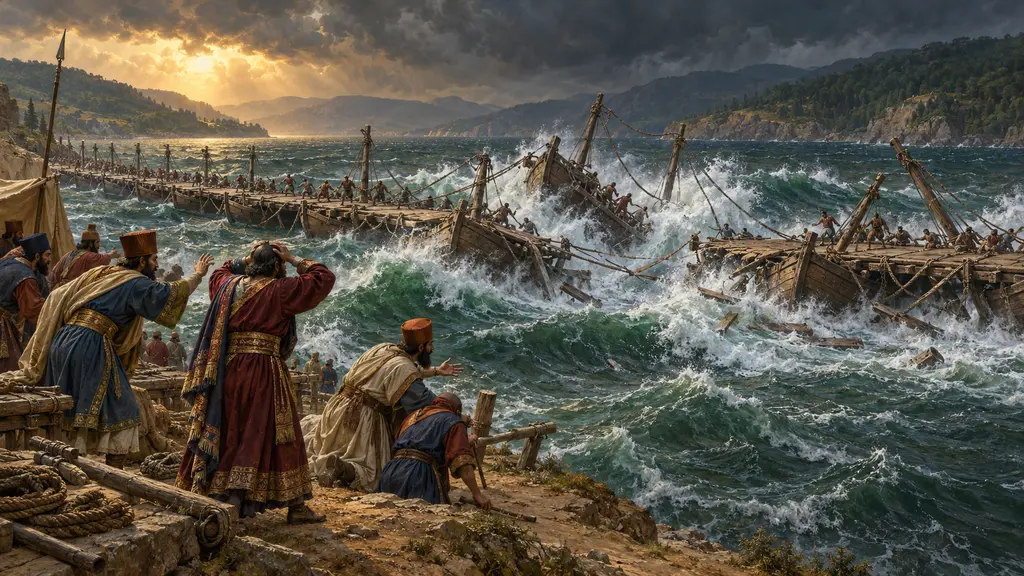
Xerxes' bridges over the Hellespont
Two bridges of boats from Abydos to Europe, built for the invasion of Greece, 481-480 BCE
In the game: Level 9: The Canal
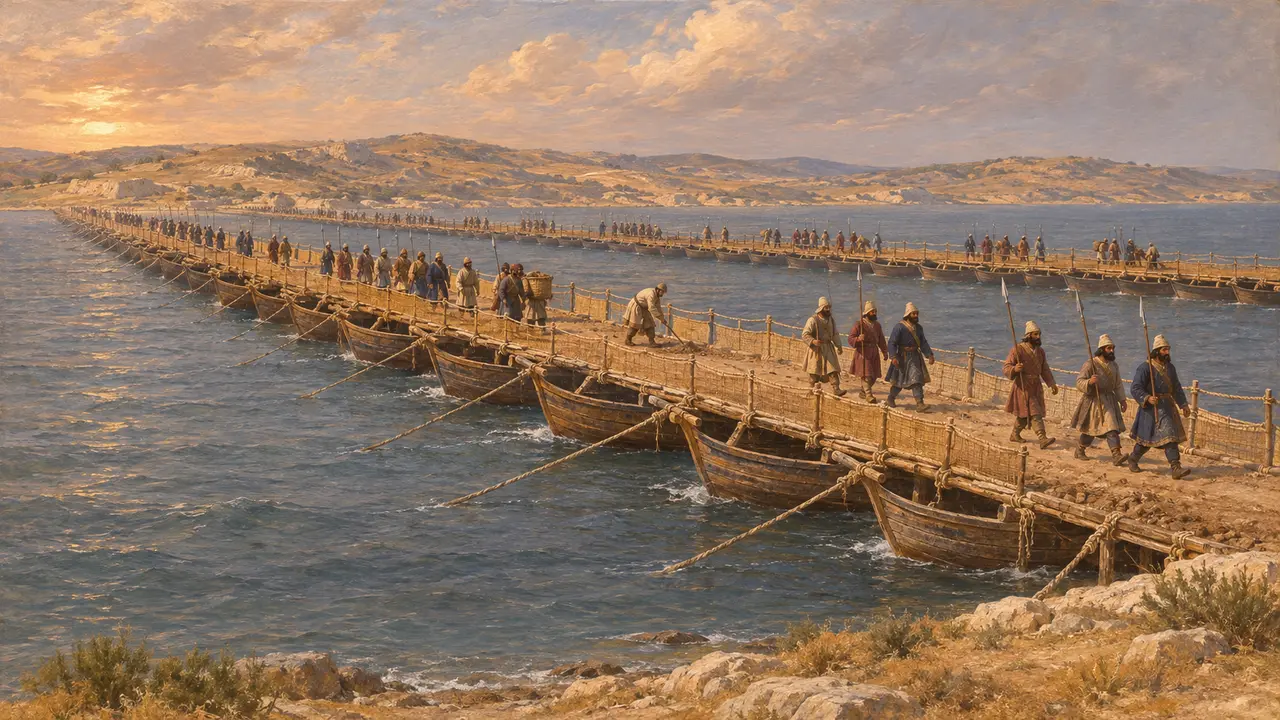
To march his army from Asia into Europe, Xerxes had two bridges of ships laid across the Hellespont near Abydos. A storm wrecked the first pair, and a second pair carried the army over in spring 480. Herodotus describes them in close detail, and for Greek writers they became a symbol of royal pride that defied the sea itself.
In the game: The game follows Herodotus: the broken bridges, the lashing and beheadings, and 674 ships, which he gives as 360 and 314 for two separate bridges. The game shows the lashing as fact; it is Herodotus's story, not a Persian record.
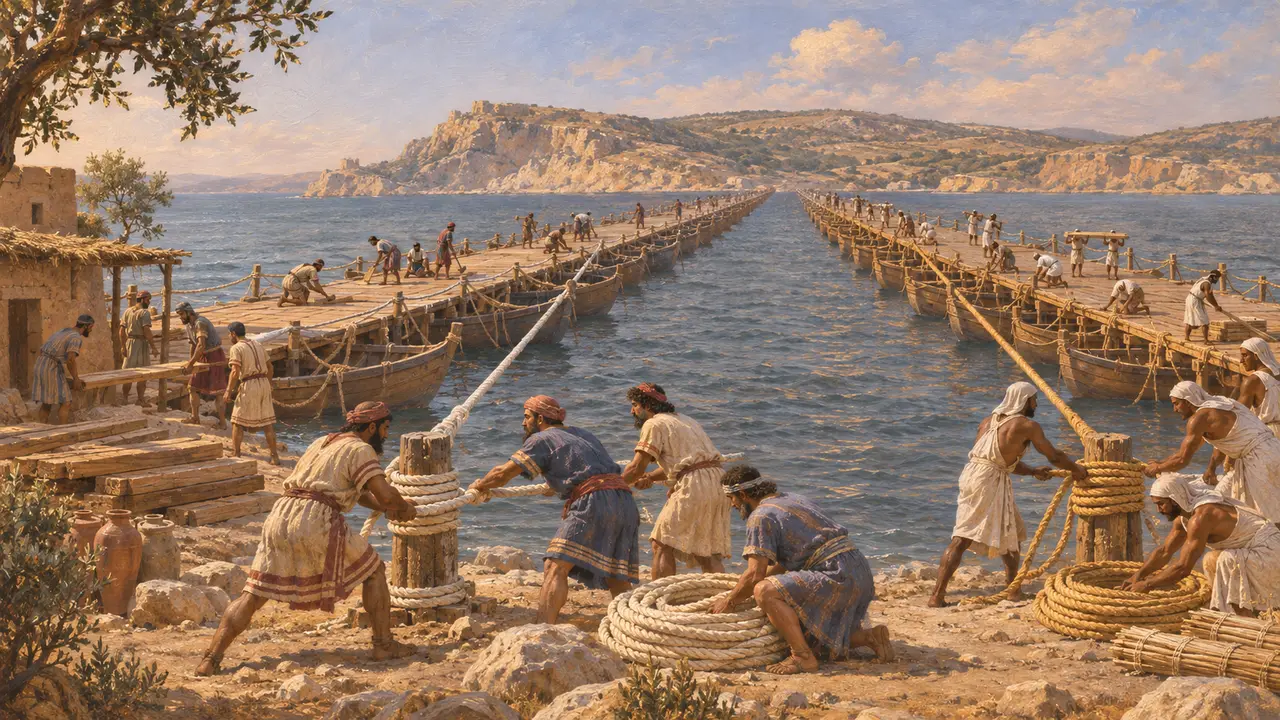
The first bridges
Ancient accountHerodotus says the work ran from Abydos on the Asian shore to a rocky headland on the European side between Sestos and Madytus, a crossing of seven stades, a little over a kilometre. Two bridges were built. The Phoenicians made one with cables of white flax, the Egyptians the other with cables of papyrus. Xerxes spent the winter at Sardis while the work went on.
Herodotus 7.32-34; 7.37
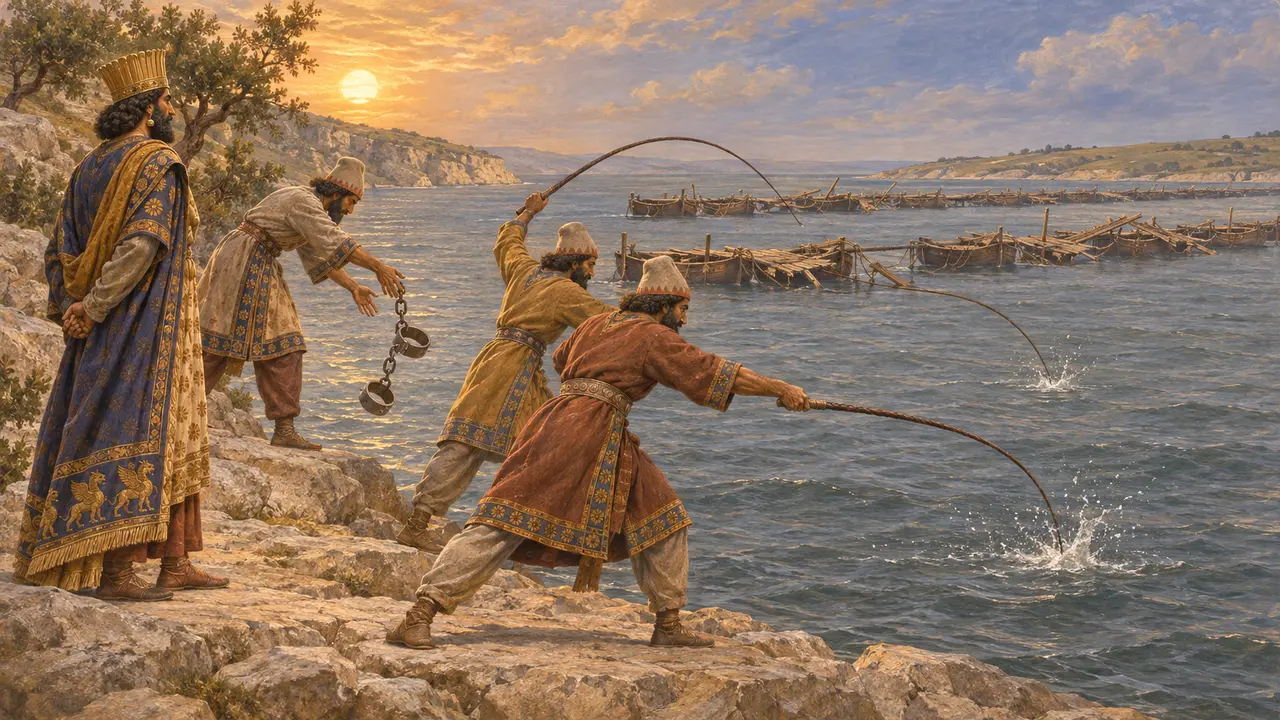
The lashing of the sea
Later legendWhen a storm broke both bridges, Herodotus says Xerxes ordered the Hellespont given three hundred lashes and had fetters dropped into it. He adds that he had heard branders were sent as well. The floggers were told to call the water bitter and to say it had wronged a master who had done it no wrong. The overseers of the work were beheaded. The tale fits Herodotus's portrait of a king who overreached, and no Persian source records it.
Herodotus 7.35
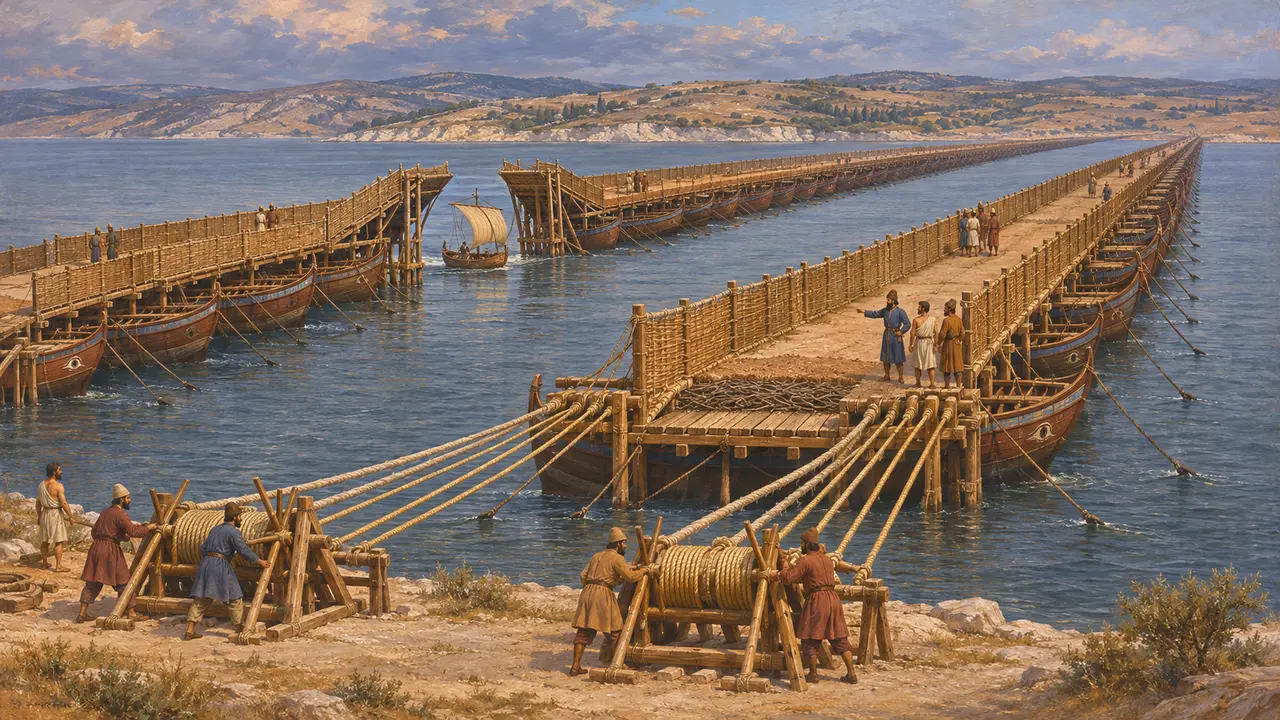
The second bridges
Ancient accountNew engineers moored 360 penteconters and triremes for the bridge on the Black Sea side and 314 for the other, held by heavy anchors. Each bridge now had two flax cables and four of papyrus, drawn taut by wooden windlasses ashore. Planks, brushwood and trodden earth made the roadway, with screens so the animals would not see the water. Gaps were left for small boats to pass.
Herodotus 7.36
How far to trust the account
DisputedNo Persian text mentions the bridges, but Aeschylus, writing in 472, confirms that the strait was bridged. Historians accept the bridging, as Darius had bridged the Bosporus, but argue over the landing places, the anchoring and spacing of the ships, and whether 674 vessels is right. Hammond and Roseman argued that Herodotus's technical account is coherent. Others note that his fetters echo Aeschylus, whose ghost of Darius condemns Xerxes for chaining the sacred Hellespont.
N. G. L. Hammond and L. J. Roseman, JHS 116, 1996; Aeschylus, Persians
The fate of the cables
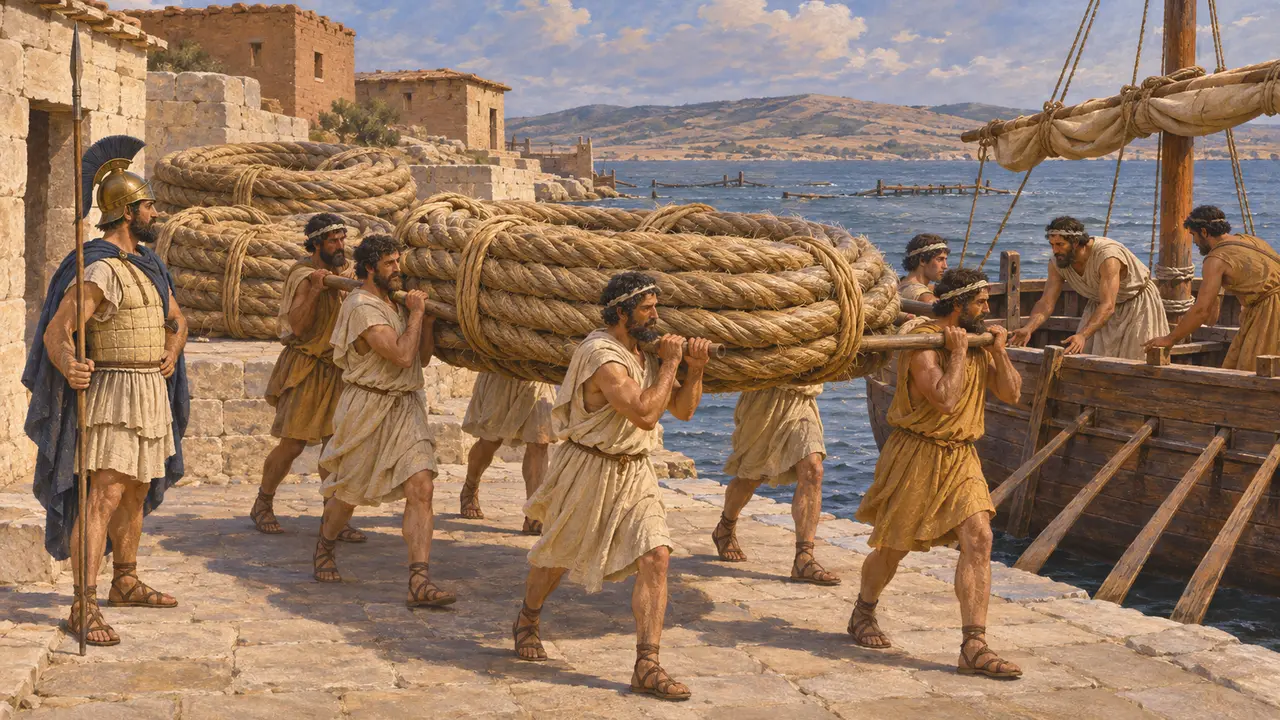
Ancient accountHerodotus says that when Xerxes' army came back after Salamis, storms had broken the bridges and the troops crossed by ship. In 479 the Greek fleet sailed to the Hellespont and found them already broken. The Athenians then besieged Sestos, took the bridge cables, and carried them home to dedicate in their sanctuaries.
Herodotus 8.117; 9.114; 9.121
Sources
- Herodotus 7.32-37
- Herodotus 8.117; 9.114-121
- Aeschylus, Persians
- N. G. L. Hammond and L. J. Roseman, The Construction of Xerxes' Bridge over the Hellespont, Journal of Hellenic Studies 116, 1996
- P. Briant, From Cyrus to Alexander, 2002