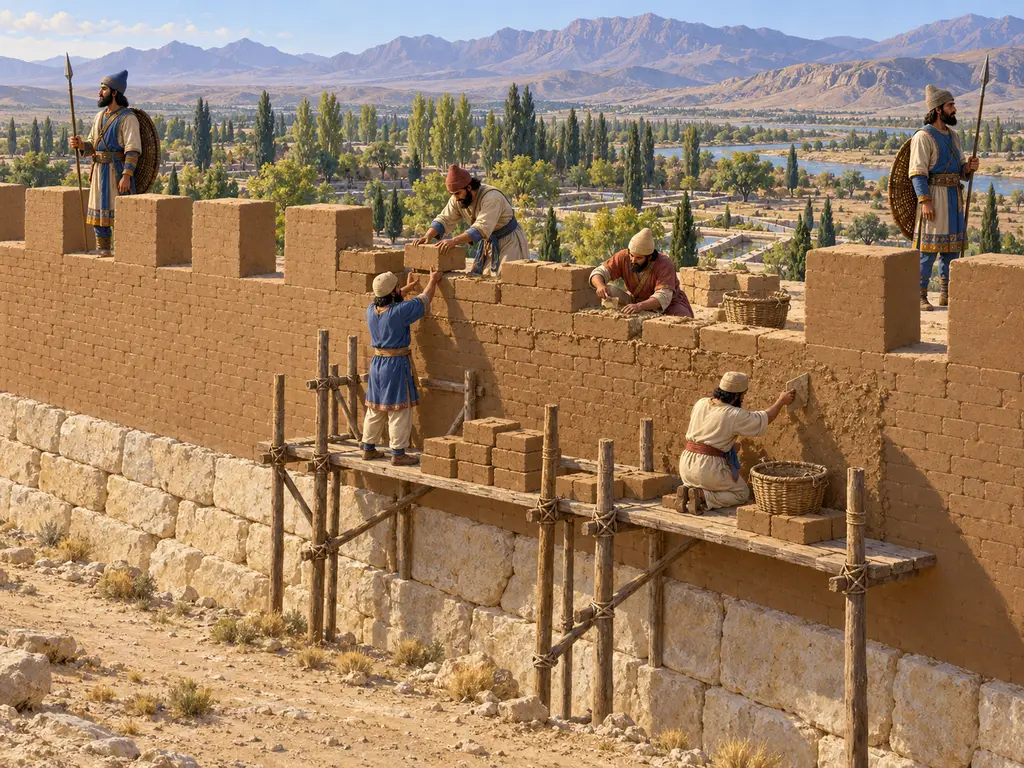
Defensive Wall
Mudbrick walls on stone footings, Near East and Aegean, 6th to 5th century BCE
Cities and royal sites of the Persian empire were ringed by walls of mudbrick raised on stone foundations, often with towers and fortified gates. Excavation and Greek writers show both how such walls were built and how Persian armies overcame them, by earth ramps, mining and storming.
In the game: The wall is dragged out on stone footings, with a gatehouse where it crosses a road; soldiers stand on it and masons repair it. Hill raiders break, burn, climb or undermine it, though in the sources these were the methods of organised armies.
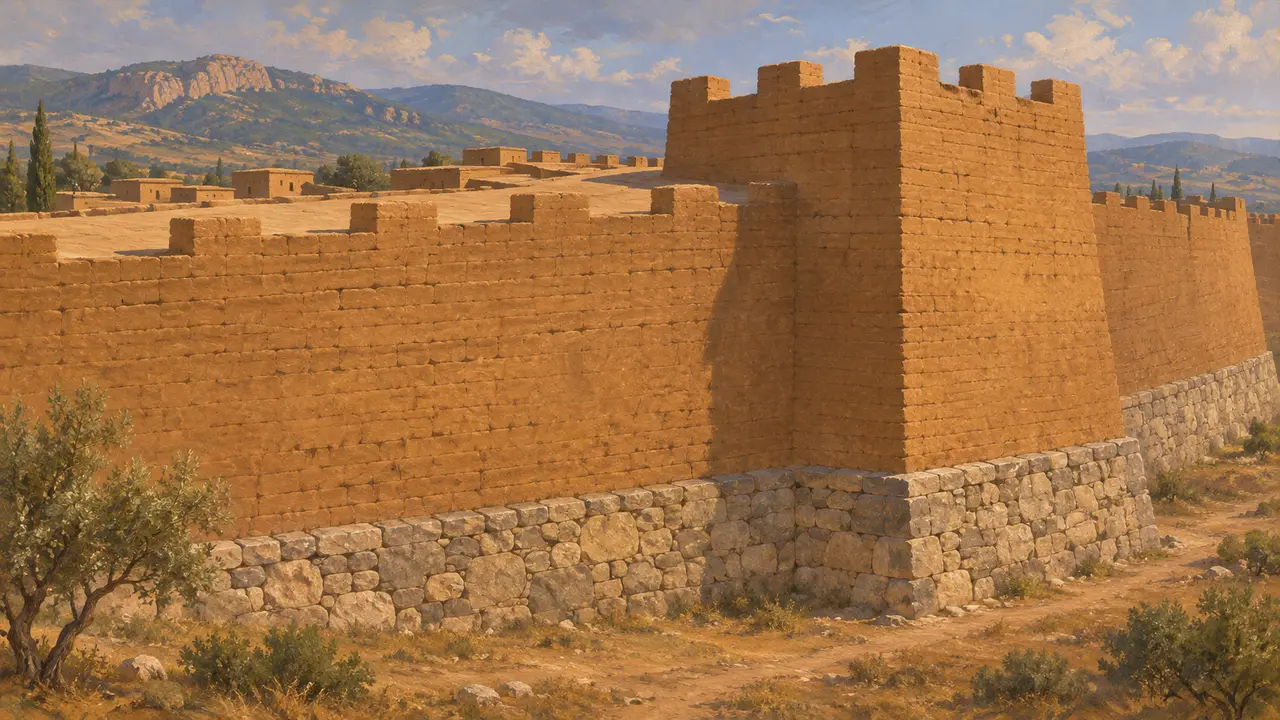
Mudbrick on a stone socle
In the recordThe usual wall of the period was a footing of rubble or cut stone that kept damp away, carrying a tall body of sun-dried mudbrick. At Sardis, excavators found a Lydian city wall some 20 metres thick at its base, built this way. At Persepolis a mudbrick wall with towers ran along the edges of the terrace and up the slope of the mountain behind it.
E. F. Schmidt, Persepolis I, 1953; N. Cahill, 'The Persian Sack of Sardis', in J. Curtis and St J. Simpson (eds), The World of Achaemenid Persia, 2010
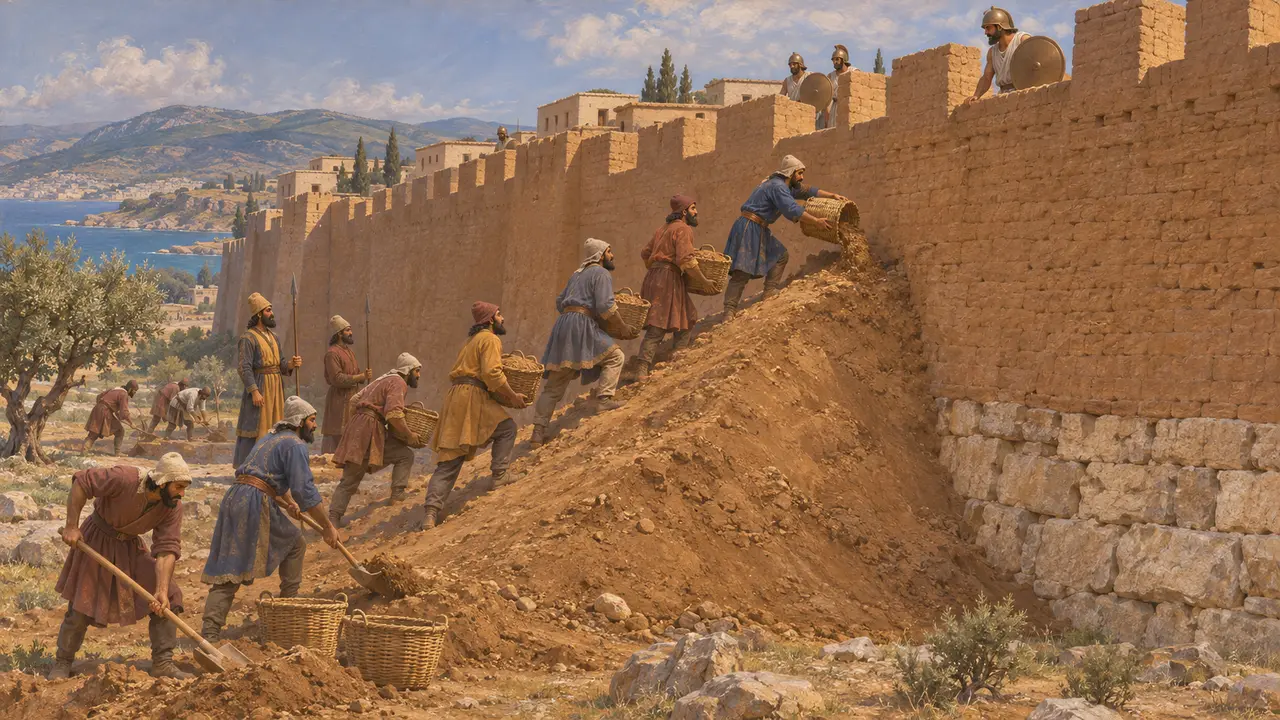
How Persian armies took walled towns
Ancient accountHerodotus says Harpagus took the Ionian cities, after Cyrus had conquered Lydia, by piling earth mounds against their walls. He tells how the Persians tried to mine under the walls of Barca in Libya, and how the defenders found the tunnels by tapping a bronze shield on the ground. In the Cypriot revolt, he says, Soli held out longest and fell in the fifth month when the Persians undermined its wall.
Herodotus 1.162; Herodotus 4.200; Herodotus 5.115
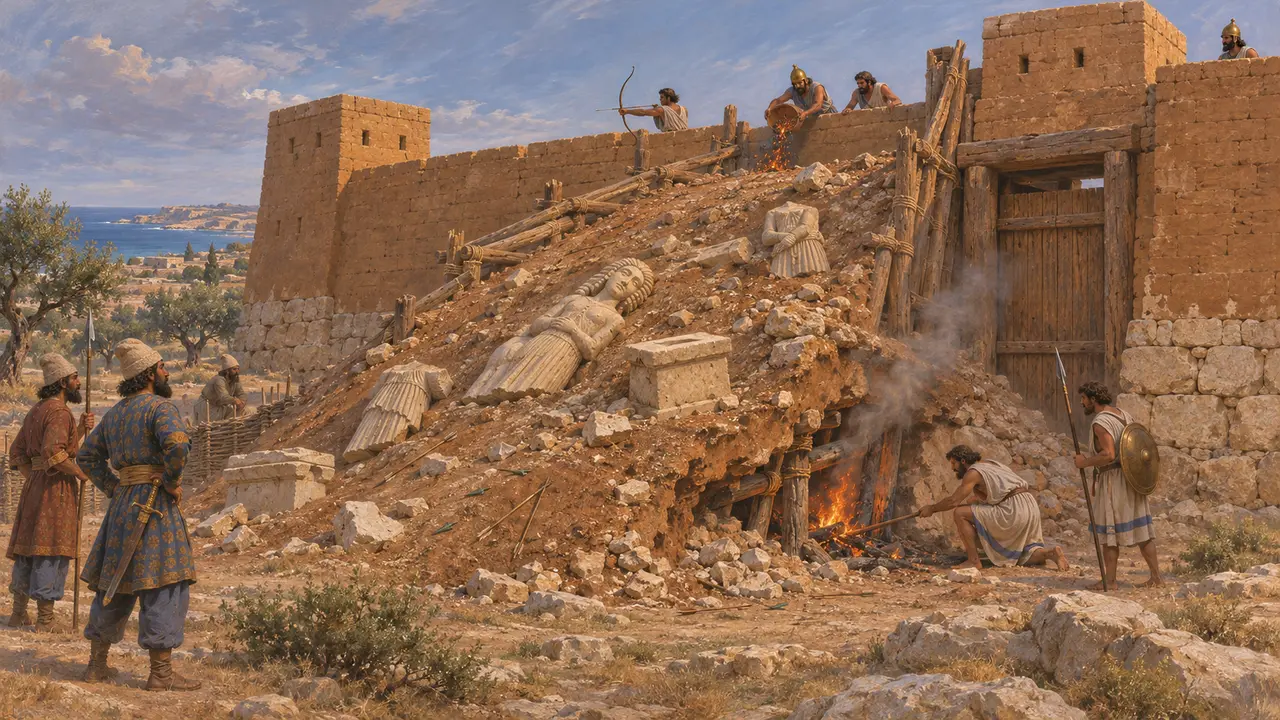
The siege mound at Old Paphos
In the recordAt Old Paphos on Cyprus, excavators uncovered a ramp of earth, stone and timber built against the city wall by the northeast gate, probably during the revolt of about 498. Into it were thrown broken statues and altars from a nearby shrine, and hundreds of arrowheads lay around it. The defenders dug tunnels under the ramp and burned out its supports.
F. G. Maier and V. Karageorghis, Paphos: History and Archaeology, 1984
The fall of Sardis
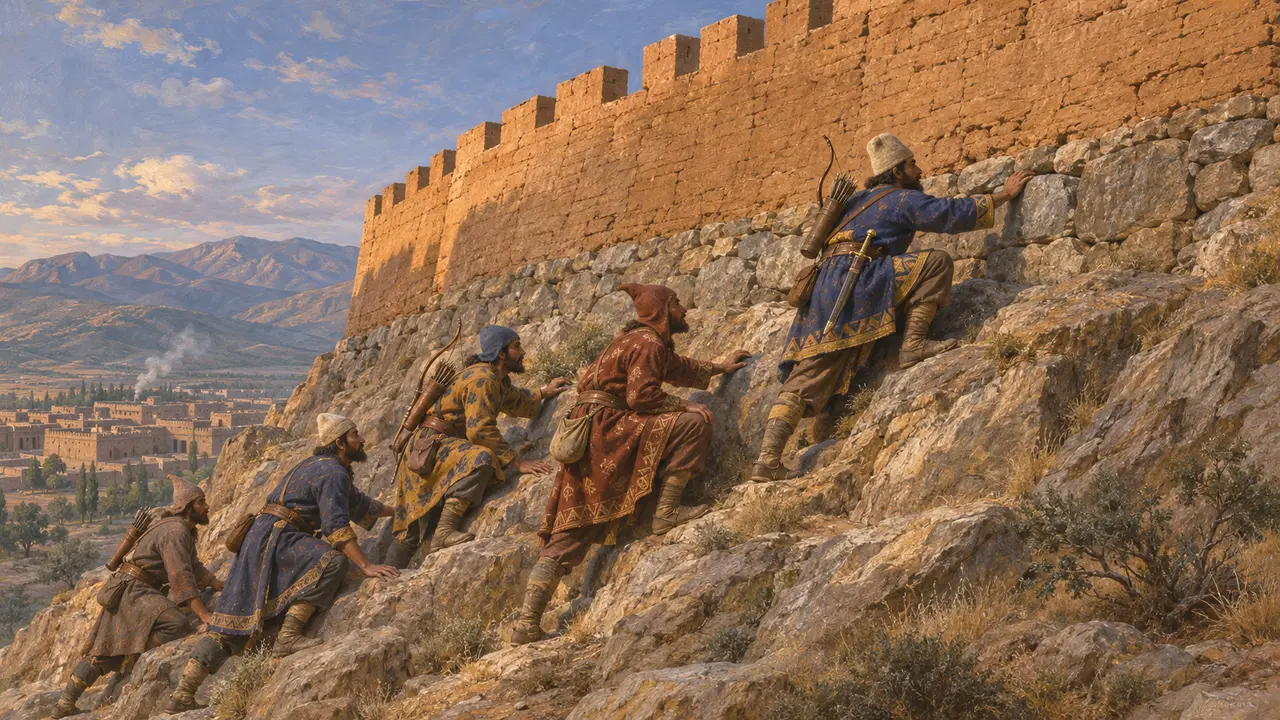
DisputedHerodotus says Cyrus's men took the citadel of Sardis by climbing a steep, unguarded stretch where a Lydian had been seen fetching a fallen helmet. Excavation shows the lower city wall was stormed and burned in the mid-6th century, with arrowheads and dead soldiers in the destruction layer. The exact year is argued over, since the Nabonidus Chronicle line once read as naming Lydia is damaged.
Herodotus 1.84; N. Cahill, 'The Persian Sack of Sardis', 2010; Nabonidus Chronicle
The walls of Athens after 479
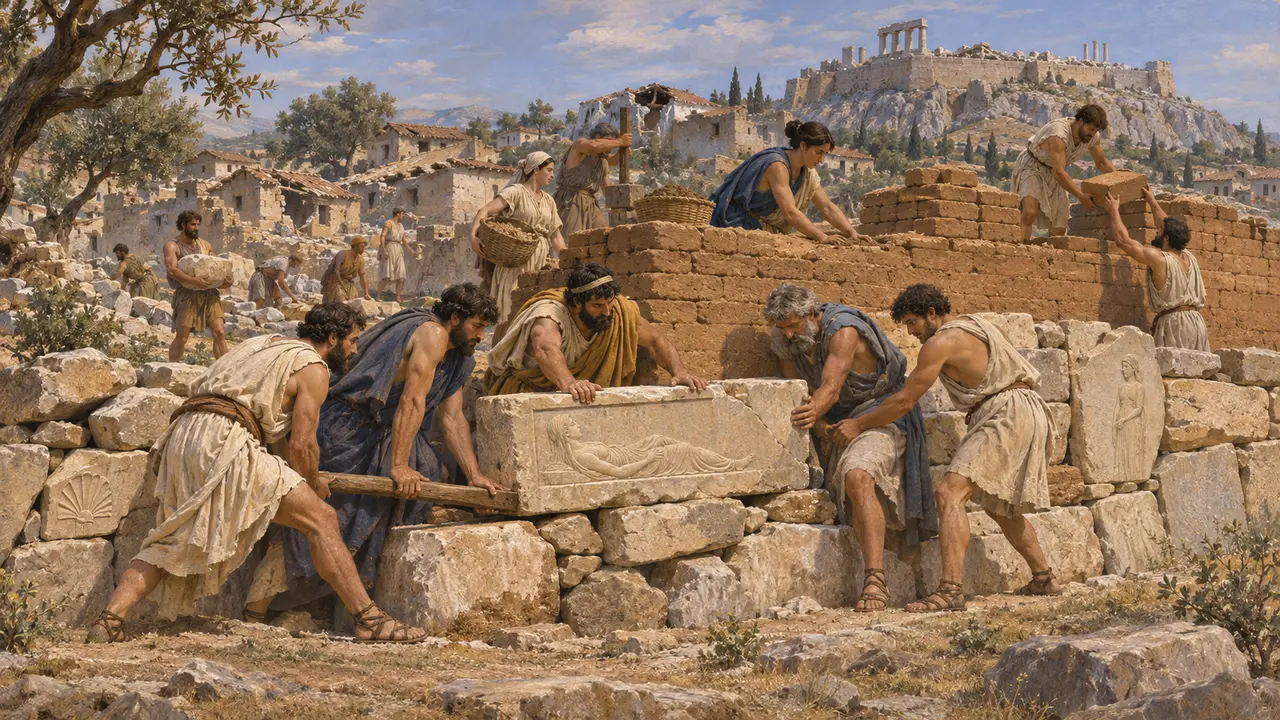
Ancient accountHerodotus says Mardonius pulled down what was left of the walls of Athens before he withdrew to Boeotia in 479. Thucydides tells how the Athenians then rebuilt their wall in haste with any stone to hand, including grave markers, while Themistocles stalled Spartan objections at Sparta.
Herodotus 9.13; Thucydides 1.89-93
Sources
- Herodotus, Histories
- N. Cahill, 'The Persian Sack of Sardis', in J. Curtis and St J. Simpson (eds), The World of Achaemenid Persia, 2010
- F. G. Maier and V. Karageorghis, Paphos: History and Archaeology, 1984
- E. F. Schmidt, Persepolis I, 1953
- Thucydides 1.89-93
- P. Briant, From Cyrus to Alexander, 2002